TEL's Sustainability
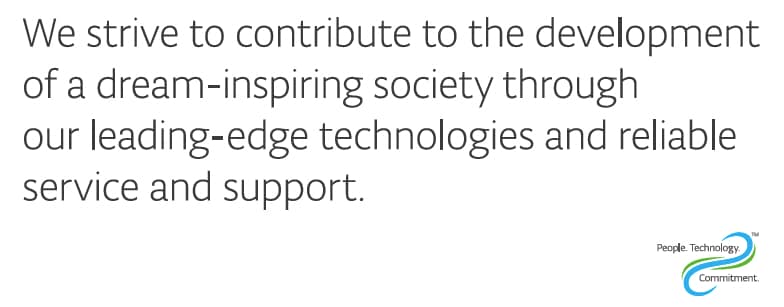
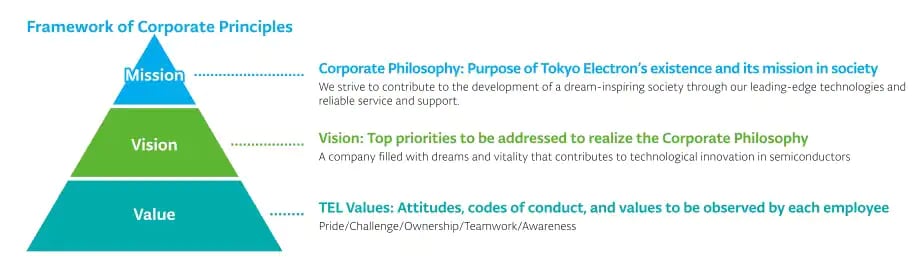
Sustainability and Framework of Corporate Principles
Tokyo Electron’s sustainability initiatives are the practice of its Corporate Philosophy through achieving its vision. We make clear the material issues in our growth and promote these initiatives. Together with the building of a resilient management foundation, by providing high-value-added products and services, we contribute to the resolution of issues and development of industry and society as well as the achievement of the SDGs.
To be a company that is highly trusted and loved by society, we work on medium- to long-term profit expansion and continuous corporate value enhancement.
Sustainability Operations
Our approach to sustainability initiatives is to practice our Corporate Philosophy through realizing our Vision. We implement sustainability initiatives that we have organized into the following four frameworks: Governance, Strategy, Risk Management, and Metrics and Targets.
Main Initiatives in the Four Frameworks
Governance |
|
||
|---|---|---|---|
Strategy |
|
||
Risk Management*² |
|
||
Metrics and Targets |
|
||
Refer to Material issues
Refer to Risk Management
Refer to Integrated Report Key Indicators for Continuous Corporate Value Enhancement
Refer to Annual Sustainability Goals and Key Indicators
Sustainability Promotion Framework
We promote sustainability activities throughout the entire Group through the following committees.
| Conference Name | Participants | Function | Meeting Frequency |
|---|---|---|---|
| Sustainability Committee |
|
|
Twice annually |
| Sustainability Global Committee |
|
|
Twice annually |
| Sustainability Monthly Meeting |
|
|
Monthly |
Report and discuss important issues at the Corporate Officers Meeting, the highest decision-making body on the executive side Corporate Officers' Meeting: Refer to the Corporate Governance System
Sustainability Manager: Person responsible for coordinating all aspects of sustainability at the Group companies in Japan and overseas companies
In addition to these committees, we invite all employees to submit examples of sustainability in the workplace, toward issue resolution and advancement of industry and society, and practice of our Corporate Philosophy. Outstanding initiatives are awarded the TEL Sustainability Award by the CEO and shared throughout the entire Group as best practices.
Initiatives for Sustainable Development Goals (SDGs)
The SDGs are a universal set of goals to achieve by 2030, which were unanimously adopted by the United Nations Sustainable Development Summit in 2015.We conduct activities on a company-wide basis, and for each CSR fiscal year and medium-term goal, and each material issue, we clarified the SDGs it is working toward through business.
Additionally, we regularly hold SDGs workshops where employees working in a variety of fields come together autonomously to share activities through business and discuss issues such as future prospects toward the achievement of the SDGs.

Tokyo Electron Supports the SDGs
In fiscal year 2022, we reaffirmed the 17 goals and 169 targets* being undertaken by the priority themes of our material issues.
169 targets reaffirmed: Our initiatives toward the 17 goals and 169 targets that make up the SDGs. Refer to 169 Targets of the SDGs
Medium-term Management Plan
This Medium-term Management Plan sets financial targets of net sales of 3 trillion yen or more, an operating margin of 35% or more, and ROE of 30% or more by fiscal 2027, to further improve our world-class operating margin and ROE. Amid the expectation of further increasing demands for semiconductors and significant future growth in the semiconductor production equipment market, we will advance various initiatives throughout the value chain, always strive for the Best Products, Best Technical Service and aim to achieve medium- to long-term profit expansion and continuous corporate value enhancement.
Financial Targets
| Fiscal Year 2025 Performance | Financial Targets (Target Year: Fiscal Year 2027) |
|
|---|---|---|
| Net Sales | 2,431.5 billion yen | 3 trillion yen or more |
| Operating Margin | 28.7% | 35% or more |
| ROE* | 30.3% | 30% or more |
ROE: Return On Equity
Participation in Global Initiatives
We actively participate in a variety of global initiatives in order to practice sustainability in our business activities.
We signed onto the United Nations Global Compact (UNGC) in 2013 and are working to contribute to the realization of sound globalization and a sustainable society through compliance with its Ten Principles in the four areas of Human Rights, Labor, Environment, and Anti-Corruption.

United Nations Global Compact
We joined the Responsible Business Alliance (RBA) in 2015, and we work with our suppliers to ensure compliance with the RBA Code of Conduct, which covers labor, environment, health and safety, ethics, and management systems.
Responsible Business Alliance
We are carrying out initiatives for reducing our greenhouse gas emissions based on international standards, and our greenhouse gas emission reduction targets for fiscal 2031 have been validated as the Science Based Targets (SBTs) as Science Based Targets initiative (SBTi). Furthermore, net zero targets to reduce greenhouse gas emissions across the whole value chain, including Scope 1, 2 and 3 set for fiscal 2041, also received SBTi validation. We will continue to implement concrete measures and manage progress as we work to achieve targets based on international guidelines.
Science Based Targets initiative (SBTi)
We participate in the CDP, an international environmental information disclosure initiative that aims to promote the disclosure of corporate information related to the climate, water, and forests. Through highly transparent disclosure and concrete measures, we will contribute to the realization of a sustainable society in collaboration with local communities.
CDP
We joined the global industry association SEMI* in 1978 as a member company, and engage in the promotion of the international standardization and sustainability efforts of the semiconductor industry as a whole. We are also a member of the Energy Collaborative (EC) established by the SEMI Semiconductor Climate Consortium (SCC) and contribute to decarbonization through the use of low carbon energy.

SEMI:Semiconductor Equipment and Materials International
Evaluation from Third-party Institutions
Our sustainability initiatives are evaluated globally from the perspectives of environment, society, and governance. Environmental initiatives include promotion of CO2 emission reductions and resource circulation, adoption and expansion of renewable energy, and development of energy-efficient technologies. Social initiatives include promotion of human resource development, maintenance of high employee retention rates, and a commitment to prevent harassment. And governance initiatives include development of highly transparent management structures and strengthening of risk management. As a result of these evaluations, we continue to be ESG investment indices. Specifically, those indices include the Dow Jones Best-in-Class Asia Pacific Index, FTSE4Good Index Series*¹, FTSE JPX Blossom Japan Index*¹, MSCI Selection Indexes*¹, and MSCI Japan ESG Select Leaders Index*¹. In 2025, we were also selected as an A List company, the highest rating awarded by CDP*², in recognition of our performance in water security and supplier engagement.
The Tokyo Electron Integrated Report 2025 received the NIKKEI Integrated Report Award 2025 Semi-Grand Prize presented by Nikkei. The report was also well-received by many of our stakeholders for our easy-to-understand integrated disclosure of concrete outcomes and vision for the future.
CDP is a non-governmental organization (NGO) founded in the United Kingdom, and supported by investors, that surveys companies and governments
around the world on climate change and water resource management.
Stakeholder Engagement
We actively create opportunities for dialogue and hold mutual communication with our stakeholders to allow us to accurately comprehend their demands and expectations as we deploy our business activities. We strive to build a solid relationship of mutual trust with all the stakeholders surrounding our company by working steadily to fulfill our roles and responsibilities in society.
Shareholders/Investors
| Relationship with
Stakeholders
|
|
|---|---|
|
Value Provided to
Stakeholders
|
|
|
Main Engagement
Opportunities
|
|
IR road show: IR activities presented directly to shareholders and investors
Customers
|
Relationship with
Stakeholders
|
|
|---|---|
|
Value Provided to
Stakeholders
|
|
|
Main Engagement
Opportunities
|
|
Suppliers
|
Relationship with
Stakeholders
|
|
|---|---|
|
Value Provided to
Stakeholders
|
|
|
Main Engagement
Opportunities
|
|
STQA: Supplier Total Quality Assessment
Employees
|
Relationship with
Stakeholders
|
|
|---|---|
|
Value Provided to
Stakeholders
|
|
|
Main Engagement
Opportunities
|
|
Local Communities
|
Relationship with
Stakeholders
|
|
|---|---|
|
Value Provided to
Stakeholders
|
|
| Main Engagement Opportunities |
|
Governments/Associations
|
Relationship with
Stakeholders
|
|
|---|---|
| Value Provided to
Stakeholders
|
|
|
Main Engagement
Opportunities
|
|
Engagement with Governments, Industry Groups,
and Other External Stakeholders
Basic Stance on “Engagement with Governments, Industry Groups, and Other External Stakeholders”
We have formulated a vision to become "a company filled with dreams and vitality that contributes to technological innovation in semiconductors." We are engaged in business activities based on TEL's Shared Value (TSV), aiming for sustainable corporate value enhancement through the advancement of semiconductor technological innovation. This is based on the idea of Creating Shared Value (CSV). The concept behind CSV is that, by using their unique resources and expertise to help resolve societal issues , companies can realize sustainable growth through the creation of social and economic value.
We believe that, for sustainable corporate value enhancement, it is important to build trusting relationships with a wide variety of stakeholders. As such, we engage with governments, industry groups, and a variety of other relevant external stakeholders in each country and region where we do business. In doing so, we aim to increase medium- to long-term profit, enhance sustainable corporate value, and help resolve issues that meet the demands of society and contribute to societal development.
Engagement with Governments
As a company that is expanding its business globally, our activities are influenced by the various polices and regulatory measures that the governments in each country and /region where we do business implement. To respond appropriately and quickly to policy and regulatory developments, we have established specialized organizations and representatives in each major country and /region where we operate. These organizations create opportunities for us to engage with relevant government personnel and communicate information about our business activities accurately and appropriately. In these ways, we are indirectly involved in policy-making processes. In addition to protecting our business interests, we seek to leverage our unique resources and expertise to help find solutions to societal problems while considering the various policies in each country or region.
-
Examples of Engagement with Governments
- Outreach to promote the understanding of our business operations
- Explanation of our business to government officials and policymakers in Japan, Europe, the U.S., Asia, and elsewhere*¹
- Participation in workforce training and development initiatives, such as the UPWARDS Program*²
- Participation in side events held during inter-governmental discussions
In the U.S., we disclose information in accordance with the Lobbying Disclosure Act. See here for details.
UPWARDS: U.S.- Japan University Partnership for Workforce Advancement and Research & Development in Semiconductors
Engagement with Industry Groups and Other External Stakeholders
We participate in a variety of trade associations and semiconductor and electronics-related industry groups to collect information relevant to our operations, including future business opportunities, policy trends and risks, and important societal issues.
In addition, through discussions with other industry group member companies, we share perspectives and acknowledge the effects of common issues on industry.
For example, through our involvement in trade associations and industry groups,*¹ including SEMI and the Semiconductor Equipment Association of Japan,*² several of our executives and employees participate in committee activities, analyze industry studies, and contribute to the formulation of policy recommendations while collaborating with other domestic and international stakeholders. In addition to facilitating the healthy development of the semiconductor equipment manufacturing industry and related industries, we aim to contribute to solutions to global issues that cannot be handled by individual companies alone, such as climate change, human rights, supply chain resilience, workforce training, and research and development.
This includes organizations that make recommendations on political and societal issues, but does not mean that we support all of the policy positions of those organizations.
Tokyo Electron’s Representative Director, President & CEO Toshiki Kawai has served as Chairman of the Semiconductor Equipment Association of Japan since May 2023.