CEO's Message
I would like to begin by thanking all our stakeholders for their continued support and trust.
Since 1963, the year that Tokyo Electron was founded, we have achieved growth by contributing to the development of the semiconductor industry through our pioneering and innovative technologies, while quickly responding to changes in the business environment. We owe what Tokyo Electron is today entirely to the support of our stakeholders. We are working to expand medium- to long-term profit and to continuously enhance our corporate value by putting into practice our Corporate Philosophy of “We strive to contribute to the development of a dream-inspiring society through our leading-edge technologies and reliable service and support.”

The Past, Present, and Future of Semiconductors
Since the invention of the transistor in 1947, technological innovation in semiconductors has been the powerful driving force behind the growth of the information and communication technology (ICT) industry. Digital devices such as computers and smartphones have become widespread, and everyone now uses the internet and platform services. We have now entered an era in which AI harnesses the vast amounts of data accumulated through these services to create new value. Furthermore, the arrival of generative AI in recent years has led to continued growth in the use of AI, and digital technology has become more closely intertwined than ever with our daily lives and industries of every kind.
The advancement of AI and the societal transformations that accompany it are often discussed in terms of an industrial revolution, but the industrial revolutions of the past have consisted of mechanizing and automating manual labor, while AI is automating intellectual labor and thought processes. The capabilities of modern AI are already a world apart from where they were just a few years ago, and with the emergence of agentic AI and physical AI, this technology is expected to evolve even further. Furthermore, in addition to conventional bit computing, the coming age of new computing that fuses quantum computing and neuromorphic computing, along with technological innovations such as 6G and 7G next-generation telecommunications standards, has the potential to transform our lives, making them even better.
“Digital & Green” and Technological Innovation in Semiconductors
However, to make this future a reality, there is an issue that must be overcome: power consumption. As AI becomes more pervasive, demand for AI data centers is rising rapidly. Conventional data centers were primarily built for storing large amounts of data and ensuring the stable operation of websites. AI data centers, on the other hand, specialize in ultra-large-scale computing. According to a report by the International Energy Agency (IEA), as AI data centers become more widespread, the amount of power consumed by data centers will increase by approximately 130% over current levels by 2030. CO2 emissions may also increase by 80%.
These projections assume that renewable energy will meet roughly half of the increase in electricity demand from data centers, but even given that, CO2 emissions are predicted to almost double over current levels. Data centers are now an important part of society’s infrastructure, but that does not give us license to disregard their environmental impacts. It is important to pursue performance improvements, such as through ultra-high-speed computation and greater data transfer bandwidth, to make AI more convenient. At the same time, further action to mitigate global warming is increasingly required. The “Digital & Green” approach, which consists of achieving both the digitalization of society and decarbonization for the preservation of the global environment, has become a global movement and a shared value.
Technological innovation in semiconductors is vital to realizing this “Digital & Green” approach. Semiconductors are evolving in four directions: higher speed, larger capacity, superior reliability, and lower power consumption. There are two approaches to semiconductor production that can be used to achieve this. The first is scaling, which has become synonymous with the evolution of semiconductors. Scaling increases the integration density of semiconductors on a chip. The second is advanced packaging, which integrates various functions. AI semiconductors are made using both scaling and advanced packaging, and the semiconductor production equipment that supports these AI semiconductors is growing in importance. This market shows high promise for growth.
Tokyo Electron’s Vision and Management Leveraging Its Strengths
Tokyo Electron manufactures and sells the equipment used to make these semiconductors. We are one of the world’s leading suppliers of semiconductor production equipment.
Our Vision is to be “A company filled with dreams and vitality that contributes to technological innovation in semiconductors.” Our Vision is rooted in TEL’s Shared Value (TSV)*¹. We will contribute to technological innovation in semiconductors that supports the “Digital & Green” approach by utilizing our expertise as a semiconductor production equipment manufacturer to continuously create high-value-added leading-edge equipment and technical services. We also consider profit to be an important measure of value in our products and services, so we pursue world-class profits. We aim for medium- to long-term profit expansion and continuous corporate value enhancement by using this profit for future growth investment. Our corporate growth is enabled by people, and our employees both create and fulfill company values. We work to realize this Vision through engagement with all of our stakeholders.
Our greatest feature is our expertise in leading-edge semiconductor manufacturing technologies and processes. Our equipment lineup covers a wide range of processes, from front-end processes, where minute transistors are formed, to advanced packaging. For many of these products, we command some of the world’s top market shares. There are over 2,000 processes involved in the production of leading-edge semiconductors such as logic devices for AI. Led by our broad product lineup, which leverages our track record as the company with the industry’s largest installed base (cumulative total of more than 100,000 units) and our patent holdings, the largest in the industry (with approximately 27,000 patents), we are continuously creating next-generation products with high added value in a timely manner.
Furthermore, under the “Manufacturing DX*² with AI & Robotics” concept, which drives innovation in manufacturing sites, last December we released Epsira™, a solution that uses AI and robots to improve both equipment and field service productivity. We have already begun supplying some of Epsira™'s services for use in the mass production sites of major customers, and going forward, we will further accelerate our efforts to contribute to enhancing customer productivity.
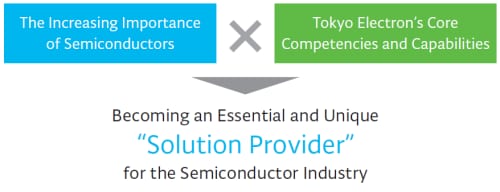
As a solution provider that solves customers’ issues and continues to contribute to ongoing technological innovation in semiconductors, we aim to become an indispensable and unique solution provider for the global semiconductor industry.
TSV: This is the Creating Shared Value (CSV) approach adapted to the Tokyo Electron Group’s business. The CSV approach aims to create social and economic value, enhance corporate value, and realize sustainable growth by leveraging company expertise to address social issues.
DX: Digital Transformation
Progress of the Medium-term Management Plan
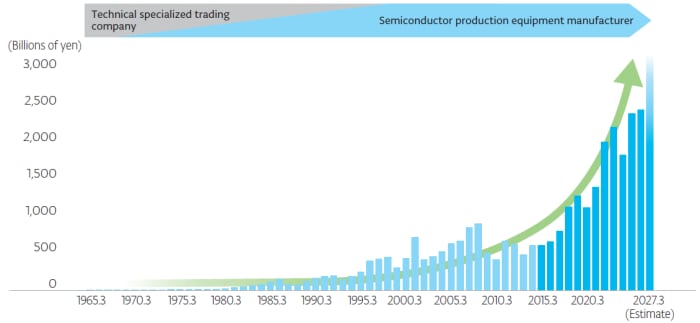
As part of our Medium-term Management Plan for realizing our Vision, we have set fiscal year 2027 financial targets for an operating margin of 35% or more and return on equity (ROE) of 30% or more, with net sales of 3 trillion yen or more.
Over the past decade, our net sales have grown fourfold and our operating income has grown sevenfold. What is more, due to the recent strong demand for semiconductors for use in AI servers, we have received many business inquiries regarding investment in leading-edge devices, and achieving net sales of 3 trillion yen or more is now within sight. It also appears likely that we will reach an ROE of 30% or more due to increases in net profit and improvements in capital efficiency. However, our business environment is changing dramatically. These changes include regulations and tariffs prompted by U.S.-China friction, the impacts of geopolitical issues such as conflict in the Middle East and the protracted Russia-Ukraine war, global inflation and currency fluctuations, and changes in customer investment plans. This has made achieving our operating margin target a challenge.
Within this business environment, it is important that we study and pursue earning power and that we adapt appropriately to the changing times. Through the steady progress we have made so far, reaching 1 trillion yen in operating income is within our sights, but to further improve our operating margin, we must focus on the following five key issues: (1) continuously providing next-generation equipment with high added value (strong “next-generation products”), (2) upgrading the installed equipment, (3) deploying advanced field solutions that leverage AI and robotics, (4) pursuing efficiency through “One-touch Start-up,” which cuts equipment start-up times in half, and (5) revising prices appropriately with respect to cost increases caused by inflation.
We have also established, and are currently implementing, a growth investment plan to refine our strengths and maximize future growth opportunities. We plan to spend 1.5 trillion yen or more on R&D investment and 700 billion yen or more on capital expenditures while recruiting 10,000 employees globally, over five years from fiscal year 2025. Through our investment in growth businesses and our efficiency improvements in existing businesses, we will constantly pursue a world-class operating margin and engage in appropriate capital allocation while working toward an ROE of 30% or more from a capital efficiency perspective.
Consolidated Net Sales
Human Resources Initiatives
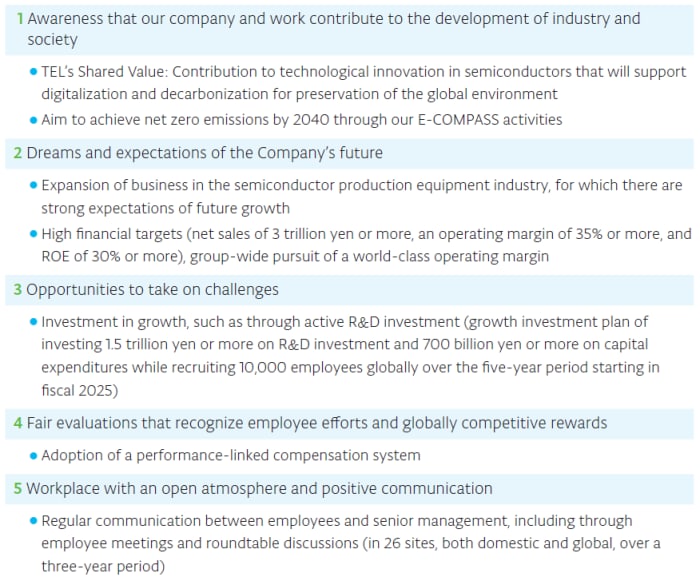
Our corporate growth is enabled by people, and our employees both create and fulfill company values. As CEO, I believe that one of my most important missions is to increase employee motivation and engagement with the company so that they can fully exercise their capabilities, so I lead us in practicing motivation-oriented management centered on the following five points.
Five Points of Motivation-oriented Management
We also recognize the importance of a diverse workforce, and we promote diversity, equity & inclusion from the perspectives of “Global,” “Generation,” and “Gender” (the “3G perspectives”). We provide various career paths and strive to enrich our training programs to support employee growth.
As a leading company in this industry, we are actively engaged in the education of students, researchers, and others responsible for the future of the semiconductor industry, as we consider this part of our mission. We will contribute to the sustainable development of the semiconductor industry by helping to develop the next generation of semiconductor talent. We will do this by supporting various industry-academia collaborations, including by participating in the U.S.-Japan University Partnership for Workforce Advancement and Research & Development in Semiconductors (UPWARDS).
Environmental Initiatives
As the importance of preserving the global environment continues to grow in society, we are working to reduce environmental impact, and above all achieve decarbonization, in all of our business activities to contribute to the realization of a sustainable society. We have set ourselves the goal of net zero greenhouse gas emissions by 2040, and we are working toward this goal in various ways. We are reducing CO2 emissions when customers use our products. We are reducing the environmental impact of logistics by reducing the amount of wooden packaging materials we use and carrying out a modal shift. Each plant and office is promoting the use of renewable energy and reducing resource consumption.
In addition to working to reduce our own emissions, we are also working with our customers and partner companies to reduce environmental impacts across the entire product lifecycle*¹. As part of this, we are implementing the E-COMPASS*² initiative, which focuses on the environment, to achieve technological innovation in semiconductors, and reduce their environmental impact throughout the entire supply chain.
Product lifecycle: The value chain from product planning, development, and design, through procurement, manufacturing, logistics, customer use, maintenance and service, to disposal
E-COMPASS: Environmental Co-Creation by Material, Process and Subcomponent Solutions
“Double-offensive” Governance
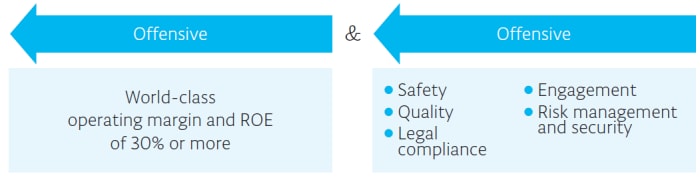
We conduct management based on the fundamental stance of “double-offensive governance,” with the aim of expanding profits in the short, medium, and long term and continuously enhancing corporate value. The first “offensive” refers to an aggressive style of business activities. We consider profit to be an important measure of value in our products and services, so we always pursue a world-class operating margin and ROE of 30% or more by providing the Best Products with innovative technology, and the Best Technical Service with high added value.
The second “offensive” refers to an aggressive style of building a management foundation. Fundamental to all corporate activities is the strengthening and enhancement of safety, quality, legal compliance, engagement with employees and other stakeholders, and security, and we aim to make them our own strengths. “Safety First” is an especially high priority for us. We monitor the safety of workplace environments using TCIR*, the rate of workplace incidents per 200,000 work hours. In fiscal year 2026, our TCIR was 0.22, which puts us in the top class among companies in the semiconductor production equipment industry. Our products already achieve a very high level of safety in terms of their specifications, and we are advancing initiatives, including a Group-wide safety campaign, to further reduce incidents caused by human and behavioral factors.
Our corporate growth is enabled by people, and our employees both create and fulfill company values. That is why we want to be a company that employees want to work at over the long term. Our turnover rate in Japan is 0.9%, and globally it is 2.2%. Both of these are notably low turnover rates for the semiconductor production equipment industry. The semiconductor industry struggles with a shortage of semiconductor talent, but we believe that, from a human capital management perspective, developing and utilizing our people from a medium- to long-term perspective is one of our great strengths.
TCIR: Total Case Incident Rate
Aiming to Become a Company That Is Cherished and Trusted by All Stakeholders
Semiconductors are creating a prosperous future and continuing to evolve, and the semiconductor production equipment market that supports them has now entered a new growth phase. To achieve our goal of becoming number one globally, we will continue to take on challenges and evolve, create high-value-added technologies that the world has never seen and only we can, and provide them to society. We will contribute to realizing the “Digital & Green” approach and evolve into an essential “Solution Provider” for the semiconductor industry and a truly excellent global company that the world needs. At the same time, we will strive to remain a company that is cherished and deeply trusted by all stakeholders and filled with dreams and vitality.
I sincerely appreciate your continued support and trust.
Toshiki Kawai
Representative Director, President & CEO
Tokyo Electron Limited

This message is the CEO's message in the Integrated Report 2026.