From Learning to Innovation
Data Scientists at TEL Digital Design Square
Culture
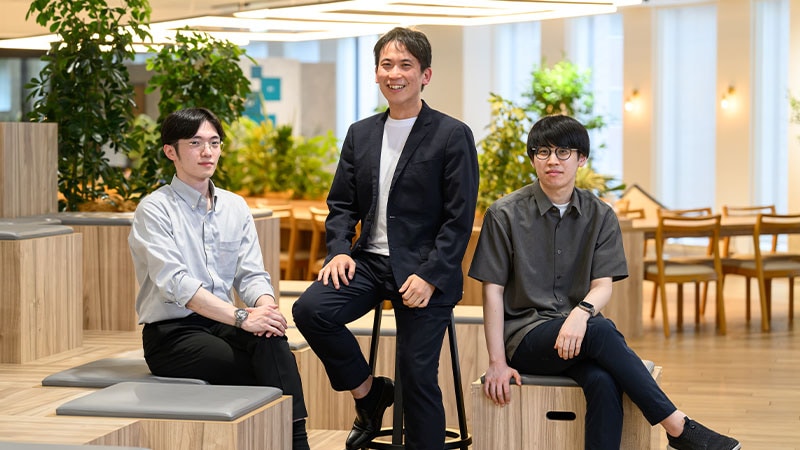
In central Sapporo, Hokkaido, Tokyo Electron (TEL) has a hub dedicated to software development. There, engineers specializing in AI and data science work every day to enhance the value of semiconductor production equipment. This article explores the site’s open and dynamic culture, where self-driven learning takes root and is translated into results in the workplace.
Members
-

Takao Nakamura
Advanced Research Group 2, Equipment Intelligence Development Department. Since joining TEL in 2020, he has been based in Sapporo, where he is involved in software development as well as the evaluation and validation of emerging technologies. -

Ren Sasaki
Control Technology Group, Equipment Intelligence Development Department. Sasaki joined TEL in 2023. His work includes exploring process conditions using equipment simulators and analyzing equipment sensor data. He also participates in an internal large language model (LLM) development project. -

Ruiki Kobayashi
Modeling Group, Equipment Intelligence Development Department. Kobayashi joined TEL in 2022. In 2024, he was assigned to Tokyo Electron Kyushu, where he worked on process improvement and anomaly monitoring, before returning to TEL Digital Design Square in 2026. He is primarily responsible for data analysis and development projects related to Tokyo Electron Kyushu.
From Software Development
to the Frontline of AI Innovation
The history of TEL’s Sapporo site dates back to 1991, when Tokyo Electron Sapporo was established. Since then, the site has specialized in the development of software for semiconductor production equipment across the TEL Group. In the 2010s, its role expanded to include the exploration and development of advanced technologies, broadening its contribution beyond software development alone.
A major turning point came on November 24, 2020, when the site was relaunched as TEL Digital Design Square (D2 Square). Guided by TEL’s vision for digital transformation (DX), the site was redefined as a hub for leveraging AI and IoT technologies to create new value for TEL’s products.
Its vision is built around four priorities: contributing to the business through advanced technologies, generating synergies through collaboration across organizations, recruiting and developing highly skilled talent, and creating an environment where employees can work with energy and enthusiasm.
Today, D2 Square is home to approximately 280 employees. One of its defining features is that, in addition to TEL’s corporate functions, software development teams from Business Units (BU) such as Tokyo Electron Kyushu and Tokyo Electron Technology Solutions are located together under one roof. Within the corporate organization, around 70 to 80 employees belong to AI and data science-related teams, and the number exceeds 100 when DX-related functions are included. The site is also responsible for developing common software platforms for equipment control systems.
Meanwhile, BU teams focus on shorter-term development projects that address specific customer needs. What makes D2 Square unique is that corporate and BU teams work side by side. While corporate teams bring expertise in AI, data science, and other advanced technologies, BU contribute deep insight into products and customer needs. This combination helps turn new ideas into practical innovations.
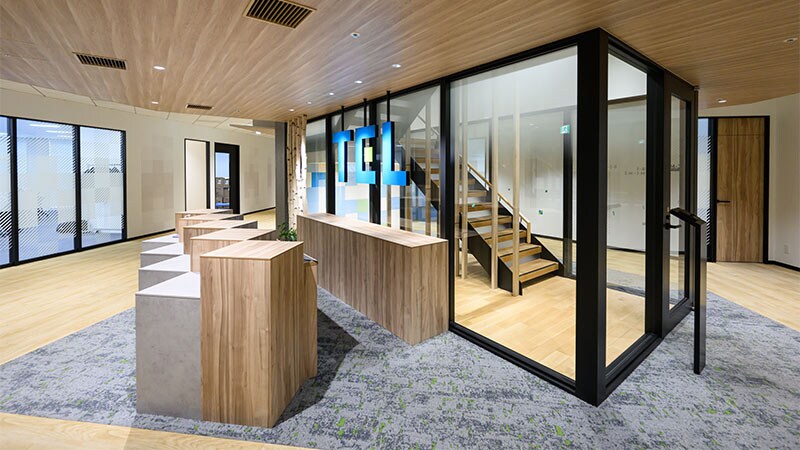
The office was designed to encourage collaboration and knowledge sharing across teams. The four-floor office is connected by internal staircases, allowing employees to move easily throughout the building without relying on the shared elevators. At the center of the office is the Innovation Hub, a space designed to support productivity and drive innovation. By bringing together employees with diverse expertise, it fosters open communication and collaboration across D2 Square and the broader organization.
The Speed of Innovation in Semiconductors and AI
From New Ideas to Real-World Applications in Less Than a Year
The semiconductor industry is highly competitive, with new technologies emerging rapidly. In this environment, how do D2 Square’s data scientists keep up with technological advances and contribute to TEL’s products? We spoke with three members of the Equipment Intelligence Development Department to find out.
As someone involved in AI and data science at D2 Square, are there moments when you feel the unique pace of innovation in the semiconductor industry?
Nakamura
Absolutely. The semiconductor industry is highly competitive, and there is constant pressure to adopt the latest technologies. As a result, the cycle from learning about a new technology to testing it in real work and putting it into practice is remarkably fast.
One example that stands out was when Meta released SAM (Segment Anything Model), a foundation model for image segmentation. At the time, we were developing an internal application that uses image data to support process development. In the field of computer vision, SAM was as groundbreaking as the emergence of ChatGPT, and it quickly became a major topic of discussion within the team. When the project leader saw the potential of the new tool, he decided that the team had to adopt it. The development schedule was completely reworked to accommodate major software design changes, and an internal application powered by SAM was released in less than a year. It was a clear example of both the speed of technological innovation and TEL’s willingness to embrace new ideas.
What do you find most exciting about working at the intersection of semiconductors, AI, and data science?
Sasaki
What fascinates me is how closely AI and semiconductors are connected. The computing infrastructure that powers AI is built on semiconductors, and as AI becomes more widespread, the importance of semiconductors continues to grow.
At the same time, the performance demands placed on semiconductors keep increasing, making the challenges in equipment development and manufacturing processes even more complex. This field gives us the opportunity to tackle those difficult challenges while also contributing to the advancement of AI itself.
Kobayashi
Unlike work that deals only with data, the semiconductor field involves actual equipment and physical phenomena. Because the technologies and processes involved are so diverse, the data also has many different characteristics. Analyzing such a wide range of data is one of the unique attractions of working in the semiconductor field.
For example, I love ramen. But even ramen would get boring if I ate the same thing every day (LOL). That’s how I feel about work. One day I’m exploring the latest image processing technologies, and another day I’m focused on more traditional data analysis. The variety is what makes the work so enjoyable.
Sasaki
At the same time, there are challenges. In data science, the data itself is critical. TEL has access to a vast amount of data, but that does not necessarily mean we always have all the data needed for a particular analysis.
Collecting additional data often requires experiments on actual equipment and support from teams on the manufacturing floor, which can take considerable time. In those situations, we make use of the latest simulation technologies as well, combining limited data with a range of complex factors to move our work forward.
Nakamura
We’re fortunate to work in an environment like D2 Square. There aren’t many manufacturing companies that have a dedicated site where people can focus on data science and AI at this scale. The work is challenging, but it’s also rewarding. There’s a real sense of excitement when you start with a question, analyze the data, and finally find an answer.
I also enjoy discussing ideas with colleagues and sharing new technologies with others. Turning those ideas into real value is one of the most rewarding parts of the job.
From Personal Growth to Practical Impact
I understand that members of D2 Square take part in external competitions and have achieved outstanding results.
Sasaki
I have been participating for about a year and a half in competitions hosted by Kaggle, one of the world’s largest data analysis platforms. In some competitions, I have won a gold medal, an achievement earned by only about the top 0.2% of participants.
What motivates you to take part in these competitions? You also form teams by reaching out to colleagues who are interested, correct?
Kobayashi
Competitions are interesting because they have clear metrics. In our day-to-day work, the highest score is not always the right answer, so I appreciate having a place like a competition where I can test my skills purely on their own merits.
Nakamura
As we go about our daily work, there are moments when we suddenly feel like taking on something difficult that is not directly related to our jobs—almost as if temptation gets the better of us. Taking on challenges outside the company also gives us an opportunity to test our abilities.
Sasaki
As the deadline approaches, it feels like the night before a school festival—exciting and demanding at the same time. It is exhausting, but somehow addictive (laughs).
Nakamura
When forming a competition team, it is important to understand what the people around you are interested in and how strongly they feel about it. The Sapporo site has open spaces where employees from different departments can interact, and club activities are also popular, so communication develops naturally. Because the organization encourages diverse connections, people naturally learn about one another’s interests, making it easier to form strong teams.
In addition to competitions, you also regularly present your work at academic conferences. How do activities like these help strengthen the technical capabilities of individuals and the organization?
Nakamura
Yes. One example is the AEC/APC (Advanced Equipment Control/Advanced Process Control) Symposium, which TEL sponsors. Many AI and software technologies can be applied across a wide range of fields, so I believe it is important to gather and share information broadly, both inside and outside the company.
Kobayashi
Competitions often expose you to technologies you wouldn't encounter in your day-to-day work, making them a great way to learn and expand your skill set. They also give you access to a wide range of data and the opportunity to learn from top-performing solutions once the results are published. Because you've worked on the problem yourself, those lessons tend to stick.
Sasaki
One of the biggest advantages of working here is that we can share what we learn from trying new technologies, regardless of the outcome. Colleagues at other sites will often look at what we've done and ask, “Could we apply that technology to this challenge?” I think those exchanges create a positive cycle where new ideas emerge from experimentation and eventually lead to real value for the business.
How do self-driven learning and individual initiatives help solve real-world challenges across the organization?
Nakamura
Simply reporting, “We investigated it and found this technology,” doesn’t go very far. But when we use real data from teams facing actual challenges to test new technologies and share the results, it creates momentum. Concrete examples help people see what’s possible and how a new approach can be applied.
Kobayashi
A big part of our job is exploring new technologies using data tied to real business challenges and figuring out how to turn those technologies into practical solutions. At the same time, a solution only has value if it can be implemented efficiently. That's why we always think about how it will be used in practice. Looking at a technology from different perspectives and considering real-world constraints often leads us to applications we hadn't initially imagined.
Nakamura
A recent example is an internal application developed by the Sapporo team that received a TEL DX award. The award helped raise awareness of the project across TEL, leading to more inquiries from other sites and opportunities to use the application more widely. Recognition like this also strengthens Sapporo’s reputation as a source of valuable technology and a reliable partner.
Shaping the Future as the Center of Epsira™
What are your ambitions for the future at D2 Square?
Nakamura
In December 2025, TEL announced Epsira™ , a new DX solutions concept designed to enhance equipment performance and operational efficiency in the field. By connecting equipment with customers’ manufacturing operations through data, Epsira™ helps improve yield, equipment utilization, and overall productivity. D2 Square plays a central role in its development, and I find it highly rewarding to be involved in a major project that will help shape the company’s future.
Kobayashi
As part of this effort, D2 Square is expected to take an even greater lead in AI across the TEL Group. Our goal is not simply to use the latest AI technologies, but to create new value in areas such as process informatics, materials informatics, and model-based control by working closely with real challenges in semiconductor manufacturing. We believe our mission is to create technologies that directly contribute to customer outcomes, including shorter R&D cycles, improved yield, and higher equipment utilization.
Sasaki
While each business unit deepens its expertise in specific equipment technologies, D2 Square can work with multiple business units and advance development from a cross-functional perspective. We can take on a wide range of challenges—not only in AI and data science, but also in equipment control, simulation, and digital twins. This environment allows us to apply our own expertise, explore new fields, and contribute to the development of technologies that will support the future of semiconductor manufacturing.
Finally, what message would you like to share with people who are interested in D2 Square?
Sasaki
I think people who can thrive in Sapporo are those who can investigate, experiment, and move forward on their own even when a problem has no clear answer. It is also important not to cling too strongly to an initial hypothesis, but to be willing to change your thinking based on the results. Many challenges in semiconductor manufacturing cannot be understood through data alone, so we need to work with equipment and process experts. Rather than trying to find an answer by yourself, you combine everyone’s expertise and develop solutions one step at a time. If that kind of work sounds exciting to you, I hope you will take an interest in D2 Square.
Kobayashi
As someone who grew up in Sapporo, I'd love to see more people discover what D2 Square has to offer, especially those who want to build a career while staying close to home. One of the things that makes D2 Square unique is the freedom employees have to pursue their interests and take on new challenges that genuinely excite them.
Nakamura
D2 Square is where cutting-edge AI technologies come together with semiconductor production equipment and the complex physical phenomena behind them. We also offer internship opportunities, so if this kind of work interests you, I encourage you to experience it for yourself.
Share