Robots Pioneering “Smart Fab”
The Future of Automated Equipment Maintenance
Technology
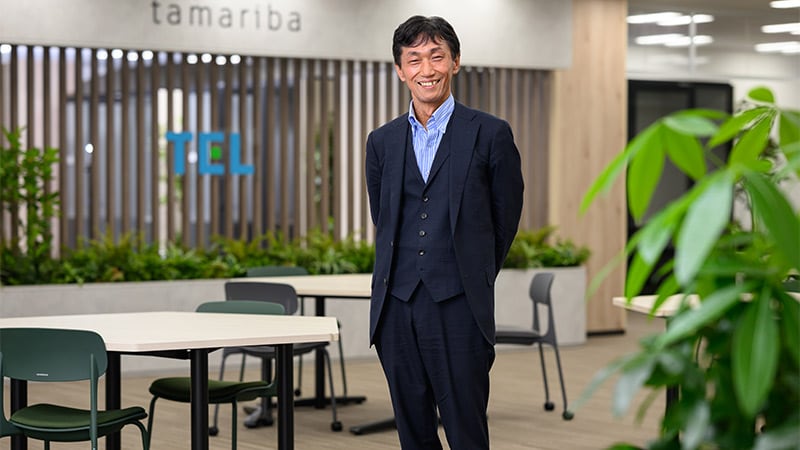
In semiconductor equipment maintenance—work traditionally supported by skilled hands, eyes, and experience—robotic automation is steadily progressing. The driving forces are addressing labor shortages and managing the increasing complexity of equipment. What kinds of changes can be achieved on maintenance floors that were long considered hard to automate? We asked an engineer developing robots for equipment maintenance at Tokyo Electron (TEL) about their current efforts and future vision.
Profile
-

Gaku Ikeda
Group Leader, PF Development F1 Group, Equipment Development Department, Tokyo Electron
Since joining TEL in 1996, he has worked consistently in software development. After working on process module and platform development for single-wafer equipment, he has been involved in a robot development project for equipment maintenance since 2022.
Why is Automating Equipment Maintenance so Difficult?
First, could you explain why automation using robots has been difficult in semiconductor equipment maintenance?
Ikeda
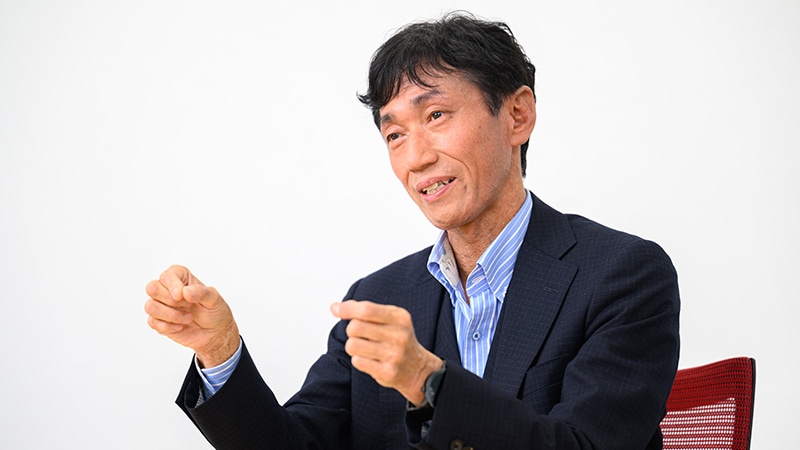
The essence of maintenance is “judging the situation.” Tasks like assembly work—handling predetermined items through predetermined procedures—are easier to automate, so production lines are well-suited to robots. But maintenance involves dealing with equipment that has been used in many different ways. It requires identifying what is broken and responding on a case-by-case basis. In practice, current work and decisions still depend heavily on the hands, eyes, and experience—and even intuition—of skilled technicians.
What specific maintenance tasks have relied on human skill?
Ikeda
In plasma-based equipment, for example, even aligning component positions requires extreme precision. Unless parts are placed exactly centered within a tolerance as small as “one sheet of paper” in clearance, the plasma will not be uniform. Even when humans do this work, it can still turn out uneven and require reworking.
But when robots do it, it becomes even more challenging. Robots that must place components without error like a single sheet of paper need precise cameras and vision sensors. However, in factories where various pieces of equipment run day and night, sensors can produce mis-detections due to time-dependent byproduct deposition from the process. If that happens, it interferes with the automation of maintenance work. Also, combining many sensors to keep the accuracy reliable is extremely difficult. For that reason, maintenance tasks that involve human intervention have not been automated for a long time.
Why is the situation changing now?
Ikeda
A major turning point has been the rapid advancement of AI and image processing, making it possible to perceive and judge things at a level close to that of humans. At the same time, labor shortages in factories are unavoidable and an urgent issue. As semiconductor manufacturing equipment keeps growing and becoming more complex, it is estimated that veteran operators will be missing in the hundreds of thousands.
What is needed based on this gap has become clearer from our customers: “We want to work toward a fab with no people.” Realizing the “smart fab,” which completely digitizes the manufacturing floor, has become an industry-wide goal.
Current Status of Robot Development for Equipment Maintenance
What changes will the smart fab bring to the industry and the factory floor?
Ikeda
The world will shift to one where “if you load materials, you get the output.” Indirect costs and labor costs can be reduced significantly, and it also enables quantitative production with less variability.
In the past, humans have been involved in production control, which inevitably brought human risk. Even if trouble occurs, it may be difficult to identify the situation or find the root cause. But because robots generate data for everything they do, when something goes wrong, you can determine what caused it. Smart fabs make stable operation and improved productivity visible.
What types of automation are underway today, specifically?
Ikeda
First, we start with tasks where the cost-benefit ratio is high—work with safety risks, and high-frequency tasks with high failure risk.
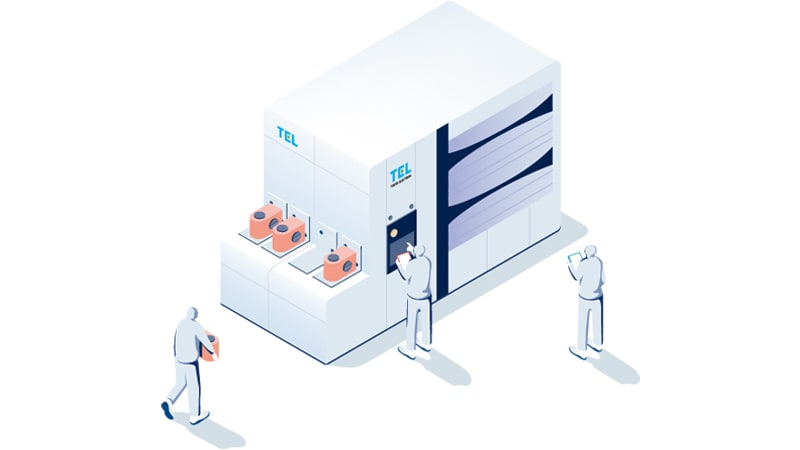
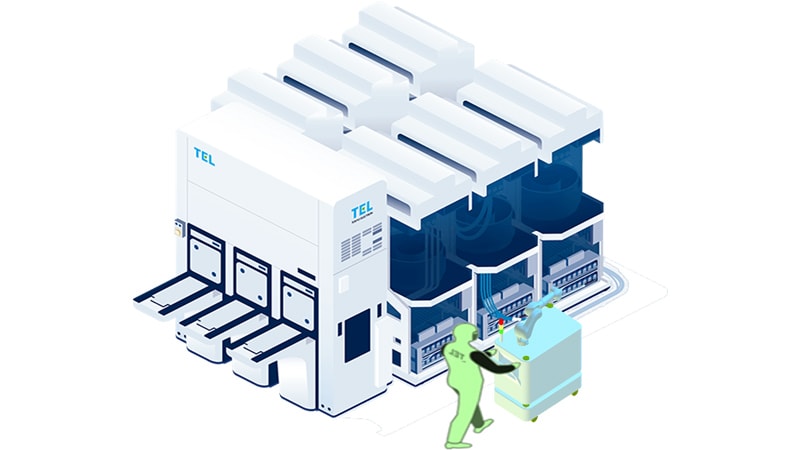
Our first major effort is a robot that replaces consumable parts of equipment. The workspace is tight, so operators have to retrieve them in somewhat awkward postures. Even though the task sounds like “just replacing parts,” it still takes a lot of effort.
In designing automation, we began by breaking the robot’s role into steps such as “removing the part” and “inserting the new part,” and then building the best workflow for each step. Eventually, we also aim to automate the transport of the replaced parts. To do that, we need to prepare the factory environment and rules so the robot can move freely through passages—since various devices and cables are placed along factory walkways.
In another area, we are proceeding with the introduction of a robot that replaces raw materials. Because replacements of raw materials happen frequently, operators’ burden is significant. For these on-site needs, we are building a path to deployment while estimating the benefits of automation.
What challenges come with implementing automation?
Ikeda
There are people who say we can just wait until “easy-to-use humanoid robots” become available without rushing to automate now. But mass-production humanoids likely won’t have much output—at least to avoid risks like accidents. It will probably take a long time for humanoids that are strong enough and fast enough to take over factory work to reach the market. And that timeline won’t work.
Also, if we want to hand all equipment maintenance over to robots, we need to develop equipment that is inherently easier to maintain. The return on investment for robot development is often hard to justify to customers. Unlike production equipment where you can say, “With automation, you can make this much,” maintenance effectiveness varies depending on how the equipment is actually used—so it is difficult to present quantified benefits. Humans are also extremely capable. When people are unsure, discussions often tilt toward keeping human labor and not fully automating yet.
Creating the Rules Needed to Make Smart Fab Possible
How is TEL contributing to the field of robots for equipment maintenance?
Ikeda
TEL’s major strength is that we have long-term customer partnerships and close collaboration with major semiconductor manufacturers, which helps it tailor products and maintain strong customer relationships. Among the many types of equipment, semiconductor factory tools have a many unique characteristics. Since TEL engages in development in close communication with customers, we can propose solutions grounded in real on-site needs.
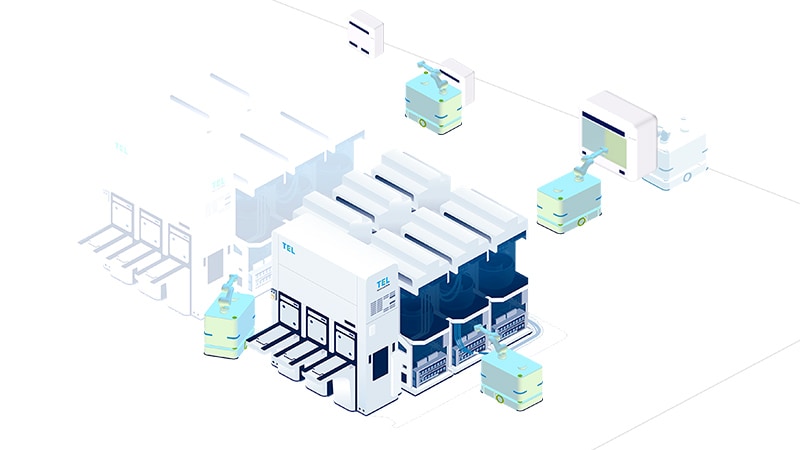
We are also working to repurpose robots built for one specific maintenance task for other tasks. Because equipment and robots are complex, it’s difficult for on-site operators to learn how to use them. That’s why standardizing parts that can be shared—such as the customer-facing interface and the cart section—is effective.
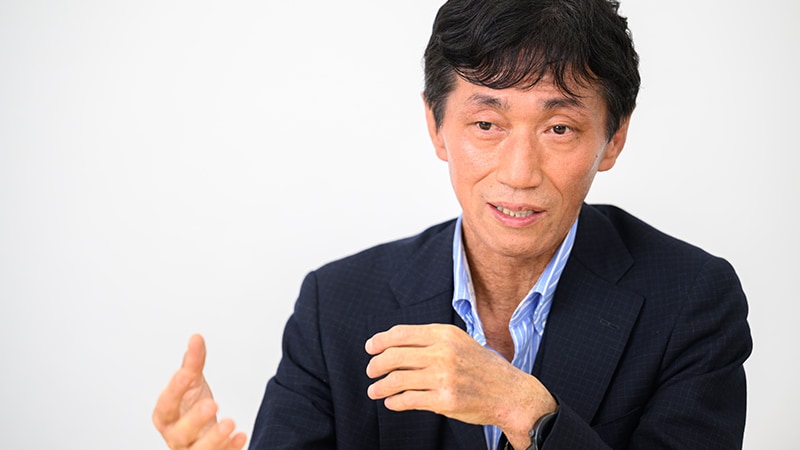
Furthermore, rule-making for smart fab is something TEL can uniquely contribute to. For example: “If robots of this size enter the factory passageways, we need to separate pedestrian routes,” or “If we use lithium-ion batteries, what safety measures should be implemented?” Such fine-grained rules will be essential for future operations. We are engaged in these kinds of proposals while incorporating the on-site conditions and customer requirements. Our role is not just to build and sell robots, but to stay alongside customers as a partner in realizing smart fab. Perhaps this is only possible because TEL has long-standing experience and trust in the industry.
What is the biggest challenge right now in moving toward full factory automation?
Ikeda
The biggest constraint is time. Both the workforce shrinking and technology evolving—leaving products under development behind—are unavoidable. If it takes years to put on the market, robots won’t be useful by the time they arrive. That makes time management—how to deliver the right solutions at the right time—the key challenge. Digital transformation (DX) is only a means for people and for the future. We don’t want to cling to today’s methods alone. We plan to decide what to do while looking ahead and balancing investment and time.
That said, this is a fast-moving technology domain, and through TEL’s presence at industry expos such as SEMICON, there are multiple ongoing discussions about joint development. It’s difficult to match the speed of startups, but we think it’s workable to proceed by leveraging collaboration—letting each party focus on its strengths and coordinating appropriately.
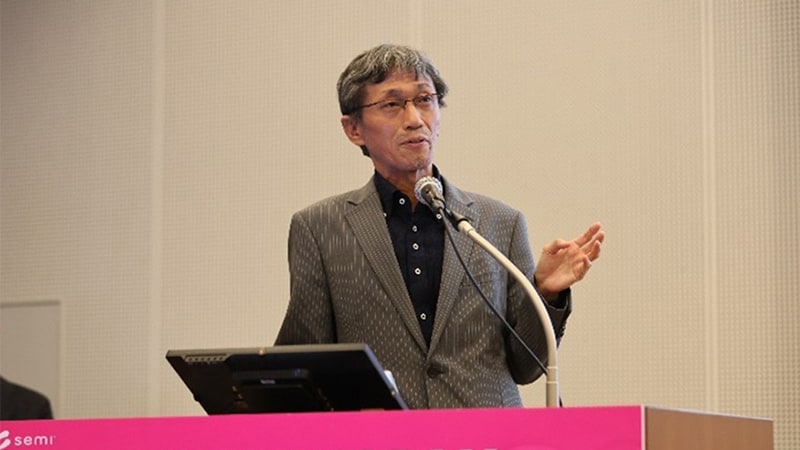
A large international expo related to the semiconductor industry
What future do you think awaits as there are advances in smart fab?
Ikeda
The development vision I’ve held based on many conversations with stakeholders is a future where the idea of “tasks only humans would do” disappears. We increasingly want to hand over work that requires people to squeeze into tight spaces and work by touch or that requires carrying heavy items in physically demanding ways—work like that—directly to robots. Even if automation advances, it’s unlikely that the number of humans working in semiconductor factories will drop to zero. But unreasonable work should be eliminated. That shift will create an environment where people can engage with semiconductor equipment more meaningfully.
The next type of work we want to automate is tasks performed at height. We want small robots to be inserted into equipment, transported to elevated positions, and do the work there—taking over from the kind of tasks where humans must attach safety harnesses and perform painful work in difficult postures.
Device and process development across generations is also incredibly interesting. TEL has many “jobs that can dramatically change society.” Through smart fab, we want to build a foundation so that the next generation can lead the industry forward.
Share