Semiconductors for the XR Era
-TEL’s Technology Supports the “Future Life We Dreamed Of”
Technology
XR (Extended Reality), which blends real and virtual worlds, is poised to transform how we live. At the heart of this shift are AR glasses and the semiconductor technologies that power them. How do cutting-edge devices work, and what kind of future will they open up? This article looks at the current environment through the technological contributions and initiatives of Tokyo Electron (TEL), a leading semiconductor production equipment manufacturer.
Profile
-

Takuya Higuchi
Group Leader, Photonics Development Group, Innovation X Lab, Tokyo Electron; Ph.D. in Engineering. After conducting research on photonics and laser technologies at the University of Erlangen–Nuremberg and the Max Planck Institute in Germany, he joined TEL. Since 2022, he has led efforts in his current group to explore new technologies and devices that can contribute to TEL’s products. He received the TEL Employee of the Year Award in 2022.
*The information is as of June 2026, when the article was created.
Expansion of the XR Market and the Underlying Technologies Needed
So what exactly is XR which is attracting so much attention now?
Higuchi
XR is an umbrella term for technologies that blend real and virtual worlds to create new experiences.
For example:
- VR (Virtual Reality) completely immerses the user in a virtual world using a headset.
- AR (Augmented Reality) overlays digital elements – such as images and information – onto the real world. This can be viewed using transparent glasses.
- MR (Mixed Reality), viewed through devices such as headsets or cameras, combines elements of VR and AR to create a space where real-world and virtual objects coexist. As an example, a virtual apple could fall off a real-world tree.
These technologies are collectively called XR and are rapidly advancing. Although not yet widespread, early products and prototypes are appearing—such as AR glasses that can overlay text or AI-generated information onto the real world.
How will XR change our daily lives in the near future?
Higuchi
I think it will change how people interact with information. Once AR glasses become common, you could see real-time subtitles during conversations in a foreign language or use an AI assistant without touching your phone. You could place virtual guide markers in a city to show only the bus stop and fare you need, or display step‑by‑step directions to your destination.
Just as many people now rely on car navigation when driving, there may come a time when we wear AR glasses whenever we go out. With AR glasses and AI supporting our every action, people will be freed from the time and effort spent on searches and other tasks, letting them focus on what they truly want to do.
What kind of device are AR glasses, the technology that will support this kind of lifestyle?
Higuchi
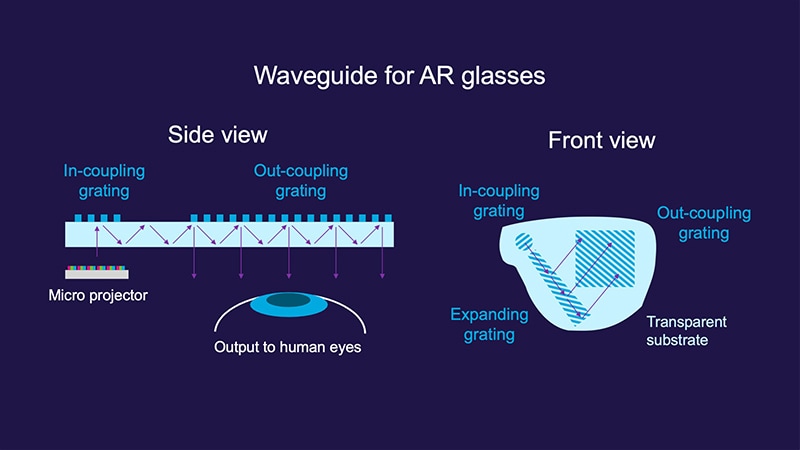
First, the lenses of AR glasses are like thin glass plates. Because they are transparent, you can see the outside world normally, but they can also display images. In other words, they let you see the real world and digital content at the same time.
A small projector that displays images onto the lens is housed in the temple (the arm) of the glasses. However, light emitted from the temple travels straight forward and won’t reach the eye as-is. The direction of the light needs to be controlled so that the image is projected onto the lens and then into the eye.
What becomes important here is the combination of total internal reflection and a structure called a diffraction grating. Total internal reflection is the effect you see, for example, when you look at the surface of water from below at an angle and it appears mirror-like. The same phenomenon also occurs at the surface of a transparent plate, which gives such plates the ability to guide light by confining it inside while it propagates.
However, confining light by total internal reflection alone won’t deliver it to the eye. That’s where a diffraction grating — a structure made of countless grooves or tiny holes, too fine to see — comes in. Passing light through a diffraction grating bends it into different directions from the original beam. By using this effect, you can change light emitted straight from a projector so that it becomes trapped inside the transparent plate, or conversely extract light that’s confined in the plate and send it out to the eye. A light device that controls light paths in this way is called a waveguide.
Various methods for projecting images into AR glasses have been debated over the years. Among them, waveguides are considered the most practical approach for mass production.
TEL’s Semiconductor Technologies Paving the Way for AR Glasses
How does TEL contribute to the mechanisms and manufacture of AR glasses?
Higuchi
Diffraction gratings have tiny periodic structures on the order of a few hundred nanometers, comparable to the wavelength of light. To achieve their best performance, you need to control structures even finer than those periodic structures. Furthermore, to widen the field of view visible through AR lenses, it’s important to increase the range of angles that support total internal reflection. That requires using materials with a high refractive index, so special glass with a higher refractive index than ordinary glass or materials like silicon carbide are likely to be adopted. Those materials tend to be hard and difficult to process.
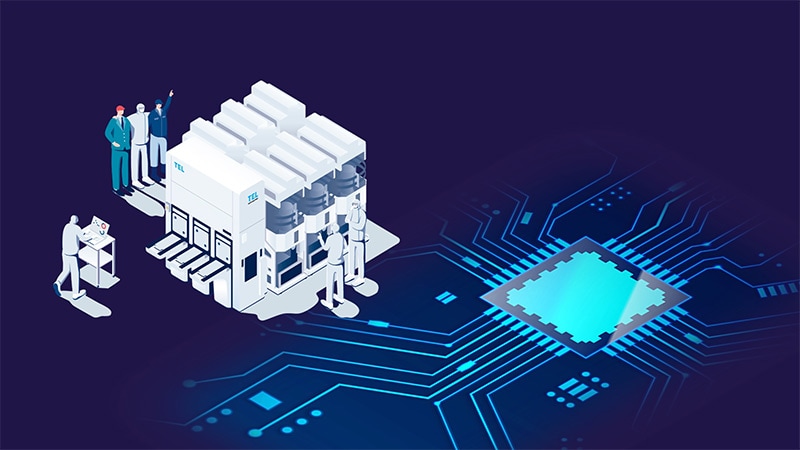
To create the tiny structures needed to manipulate light and to machine hard-to-process materials, TEL’s semiconductor manufacturing expertise is a huge asset. The nanometer-scale structuring routinely used in semiconductor device fabrication makes it possible to produce features even smaller than the wavelength of light with high precision. Although special glass and silicon carbide are difficult to handle, cutting them into wafers (disc-shaped substrates made of silicon or other materials used in the manufacture of semiconductor devices) allows suitable processing with semiconductor equipment. By combining TEL’s proven thin-film deposition, etching, and coating technologies developed for semiconductor production, we can offer manufacturing methods that are well suited to mass production.
Repurposing our long-refined semiconductor processes is the shortest path to scaling up AR glasses as a new device and it represents a major business opportunity for TEL.
Even with a solid foundation, repurposing technologies and equipment comes with many challenges. What are the difficult aspects of XR-related research?
Higuchi
Of course, some technologies can be transferred directly, but many require various adaptations. A major difference is that the materials we’re dealing with are transparent. For example, when you want to inspect a wafer inside equipment, you shine light on it to check its condition. With AR-glass materials, which are transparent, that same approach won’t work. Even if the size is similar, thermal conductivity and electrical properties differ greatly, so we must devise suitable manufacturing methods for each case.
A good analogy would be this: despite having a kitchen with knives and pots and knowing how to chop vegetables, it feels like you’re about to cook a brand-new dish for the first time. That said, TEL has been making the demanding dish of semiconductors for years, so there’s no doubt we have excellent knives and cooking skills.
Are there any other strengths TEL brings to AR-glass manufacturing?
Higuchi
Our service that keeps production equipment running stably is another major part of TEL’s strength. If AR glasses reach mass production in the hundreds of millions of units, that kind of stability and reliability will be crucial.
Of course, producing new technologies and devices can’t be done by a single company alone. Like in the semiconductor industry, a successful outcome depends on an ecosystem of partners — equipment makers, material suppliers, and others —working together. That’s why TEL is also aiming to help build the XR-device ecosystem. By delivering reliable products and services as an equipment manufacturer, we can play an important supporting role.
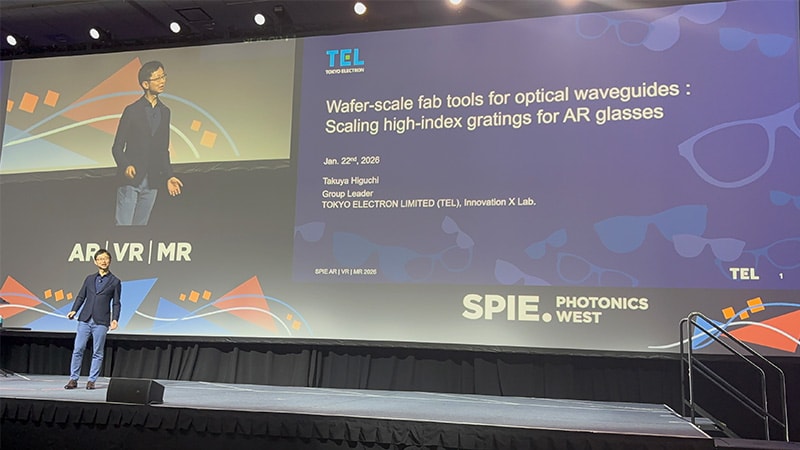
An international conference specializing in optics and photonics
TEL Leading the Way to a New XR Ecosystem
How will advances in semiconductor technology affect AR glasses?
Higuchi
Having just a few optical components such as waveguides isn’t enough to deliver compelling AR experiences. To provide everyday reliable AI services through AR glasses, we need far more powerful AI and an information infrastructure to support it — developments that depend on progress in semiconductors.
Semiconductors are also central to the AR glasses themselves. For a device you carry and use daily, you must balance high performance with low power consumption. Offloading heavy computation to a smartphone in your pocket can help, but fast communications and high-quality image rendering in the glasses remain essential. Those functions require highly advanced semiconductor technologies.
TEL continues to work toward semiconductor innovation. I believe our efforts will play an important role in the semiconductor advances needed to realize AR and XR experiences people can actually use. As a result, convenient devices will become part of everyday life and the gap between people and AI will shrink — a future that may not be far off. Growing demand for semiconductors will further stimulate industry development.
What makes working on future technologies like XR rewarding through semiconductor manufacturing?
Higuchi
Computers that once filled gym-sized rooms became personal computers, then smartphones, and now devices everyone carries thanks to advances in manufacturing that made semiconductors smaller and more powerful. Those big transformations reshape lifestyles and will do so again for the next generation.
When I was a child, many people on trains read long, folded newspapers. Now, everyone looks at their smartphones, but that posture — hands occupied and head down — is not necessarily natural. If glasses-style devices like AR become widespread, people will be able to access information more seamlessly. The way people relate to information will change because of semiconductor progress. For that future, TEL wants to contribute by providing the manufacturing technologies to realize new devices.

Finally, what kind of future do you think people will gain as XR advances?
Higuchi
Until now, people couldn’t truly send themselves somewhere else. You can send your voice by phone or your image by video, but not the feeling that a person is actually there. As XR evolves, I think we’ll be able to send a realistic presence somewhere while our bodies stay where they are. Without physical contact, you could project a virtual self next to someone that feels as real as if you were there. That would free people from being tied to a location.
Will such an era, like something out of a sci‑fi film or manga, really come? If we look back, humanity has a history of actually creating the items it once imagined. Because we can already imagine the future XR will bring, I’m convinced it will someday become reality. I hope TEL’s technologies can help turn those wishes — 'wouldn’t it be great if this existed?’ — into real products and lead society forward.
Related Content
Share